
How oral tradition, regional styles, and individual musicians shape the melodies we know today.
If you look up a traditional Irish tune in different collections, you may notice something curious: the melody is rarely exactly the same.
A jig might begin with a slightly different phrase. A reel may have an extra note in one version or a different ending in another. Sometimes even the key or the title has changed.
Which version is the correct one?
In many cases, there is no simple answer. Unlike a musical work that is primarily transmitted through an authoritative written score, Irish traditional music has developed largely through musicians learning from other musicians. Tunes have been passed down, remembered, adapted, and occasionally transformed over generations.
The existence of different versions is therefore not necessarily a problem with the sources. It is often a consequence of how the tradition works.
A Musical Tradition Based on Listening
For much of its history, Irish traditional music was transmitted primarily by ear.
Musicians learned tunes by listening to family members, neighbours, travelling musicians, or other players at dances and social gatherings. Written music existed, and printed collections became important sources, but notation was not the only means of preserving the repertoire.
Learning by ear does not mean that melodies were remembered carelessly. Experienced traditional musicians can reproduce intricate musical details with remarkable accuracy.
Nevertheless, oral transmission allows melodies to change.
A musician might remember a phrase slightly differently, prefer an alternative ending, or incorporate a variation heard from another player. If that version is subsequently learned by others, the change may become part of a local or personal tradition.
Over time, a tune can develop several recognisable forms, all sharing the same melodic identity.
What Actually Changes Between Versions?
Not every difference between two performances represents a different version of the melody.
It helps to distinguish between three closely related aspects of traditional music.
1. Ornamentation
Traditional Irish musicians frequently embellish melodies with ornaments such as cuts, rolls, and other instrument-specific techniques.
A fiddle player may decorate a sustained note, while a flute player might articulate the same passage differently. These embellishments can vary even when the underlying melody remains unchanged.
Ornamentation is often part of an individual performance rather than a permanent alteration of the tune.
2. Melodic Variation
Sometimes musicians change the melody itself.
They may substitute one note for another, alter a short phrase, simplify a passage, or introduce a different melodic ending.
Such changes may occur spontaneously during a performance, particularly when a tune is repeated several times.
Some variations disappear after a single performance. Others become established features of a musician’s personal setting.
3. Distinct Settings
When particular melodic choices become relatively stable, they may be described as different settings of the same tune.
Two settings might differ in several bars while retaining enough of the melody’s characteristic structure to remain recognisable as the same piece.
The distinction is not always clear-cut. In some cases, melodies diverge so far that musicians eventually regard them as separate but related tunes.
These categories are useful for understanding the differences, although ornamentation, variation, and established settings often overlap in actual performance.
Regional Traditions and Local Preferences
Irish traditional music is not a single, completely uniform musical style.
Different regions developed distinctive approaches to rhythm, phrasing, ornamentation, and repertoire.
The fiddle traditions associated with Donegal and Sliabh Luachra, for example, are often discussed in terms of their characteristic playing styles and musical influences. Counties Clare, Sligo, and Galway also have important traditions associated with particular musicians and approaches to performance.
However, regional style should not be confused with a fixed regional version of every tune.
Two musicians from the same area may play noticeably different settings, while musicians living far apart may share almost identical melodies.
Regional traditions are best understood as overlapping patterns of musical practice rather than rigid geographical categories.
As musicians travelled, moved abroad, and exchanged repertoire, tunes crossed regional boundaries. Individual versions travelled with them, sometimes acquiring new characteristics along the way.
The Influence of Instruments
The instrument on which a melody is played can also affect its development.
A phrase that feels natural on the fiddle may require a different approach on the uilleann pipes, flute, concertina, or guitar.
Instruments differ in range, articulation, fingering, and their possibilities for ornamentation. Musicians may respond to these characteristics by altering certain details of a tune.
For example, a fiddle player can sustain a note while changing its intensity and articulation with the bow. A flute player must shape the same phrase through breath, tonguing, and fingering. A guitarist may choose a different octave or simplify a rapid ornament to preserve the melodic flow.
These choices do not necessarily create a new melodic setting. They may simply reflect different ways of interpreting the same tune.
But when instrumental adaptations become established and are passed on to other musicians, they can contribute to the development of distinct versions.
What About the Old Tune Books?
Printed collections are invaluable sources for the history of Irish traditional music.
Collectors such as George Petrie, Patrick Weston Joyce, and Francis O’Neill preserved large numbers of melodies that might otherwise be much more difficult to trace today.
Yet an important distinction must be made: a tune appearing in an old collection is not automatically the original version.
Collectors documented melodies available to them at particular times and places. The published notation often represents a particular setting, sometimes shaped by editorial decisions.
A printed tune may therefore tell us how a melody was recorded or presented at a certain point in its history, but not necessarily how it sounded when first composed.
In many cases, the earliest known written version is simply the earliest surviving evidence.
This is particularly important when comparing historical collections with modern recordings.
A contemporary session version may differ considerably from a nineteenth-century transcription without either being inherently incorrect.
Both can provide valuable information about the tune’s musical history.
Recordings Changed the Way Tunes Travel
The development of commercial recording, radio, and later digital media introduced another important influence.
Recordings allowed musicians to learn from performers they might never meet.
In the early twentieth century, recordings by Irish musicians such as the Sligo fiddler Michael Coleman became influential far beyond their immediate communities.
A particular interpretation could now reach musicians across Ireland and the Irish diaspora, encouraging the adoption of certain settings, ornaments, and stylistic details.
This did not bring melodic variation to an end.
Instead, recordings introduced new ways for versions to circulate. A setting that might once have remained local could become widely recognised, while other versions continued to exist alongside it.
Today, online recordings, notation websites, and digital archives make it easier than ever to compare different interpretations of the same tune.
They can also make one particular setting seem authoritative simply because it is widely available.
Popularity, however, is not the same as historical originality.
One Tune, Several Names
Differences are not limited to the notes.
Traditional tunes frequently circulate under more than one title.
Names may change through translation, local usage, association with a particular musician, or the preferences of collectors and publishers.
A tune may be named after a person or place in one collection and appear under a completely different title in another.
The opposite problem also occurs: different tunes sometimes share the same name.
Consequently, identifying a tune solely by its title can be misleading.
When researching traditional melodies, it is often more useful to compare their musical phrases and structures than to rely on titles alone.
Toss the Feathers: When One Title Refers to Different Melodies
A particularly interesting example is the traditional Irish reel Toss the Feathers.
If you search for this tune in traditional music collections, you will encounter several settings. But there is an additional complication: the title is commonly associated with two substantially different reels.
One is generally played in E Dorian, while another is commonly found in D Mixolydian.
Both belong to the Irish reel repertoire, and both circulate under the name Toss the Feathers. Yet their melodic material is sufficiently different that they are generally treated as distinct tunes rather than simple transpositions or minor variations of one melody.
This is an important distinction. A change of key does not, by itself, create a different tune. In this case, the differences go beyond transposition.
The E Dorian Reel
The E Dorian Toss the Feathers is widely played in traditional Irish music.
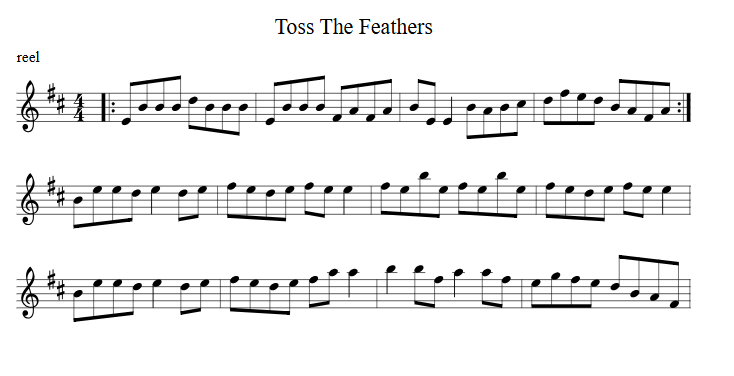
E Dorian has a minor third but a major sixth, giving it a characteristic modal sound that differs from natural E minor.
Within this reel, musicians play numerous melodic settings. Some differ only in ornamentation or small details, while others contain more substantial alterations to particular phrases.
A useful illustration of this diversity is provided by the Irish fiddler Kevin Burke, who has taught several versions of the E-centred tune.
His approach demonstrates how a recognisable traditional melody can accommodate different melodic choices without losing its essential identity.
The D Mixolydian Reel
Another well-known reel called Toss the Feathers is commonly played in D Mixolydian.
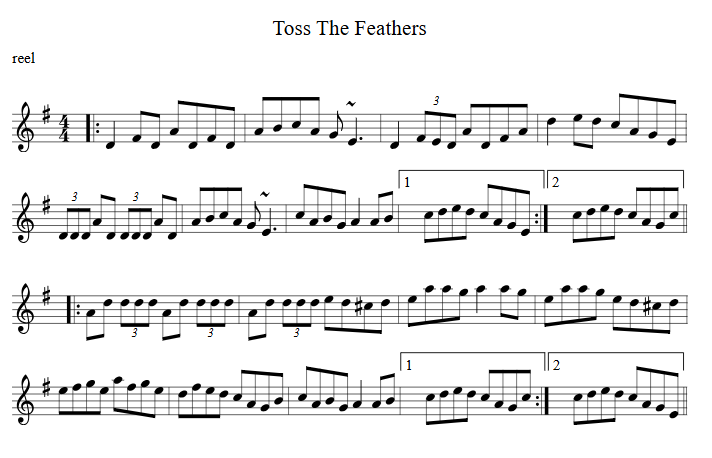
D Mixolydian resembles D major but contains C natural rather than C sharp.
This distinction is particularly relevant when harmonising the tune, since the modal character can be obscured by an accompaniment that assumes conventional D major harmony.
Although this reel shares its title with the E Dorian tune, it has a different melodic identity.
Simply transposing one reel into the key of the other would not make them equivalent.
What Can We Learn From This Example?
Toss the Feathers illustrates two different phenomena that are easily confused.
First, a particular tune may exist in multiple settings. These settings share a recognisable melodic foundation while differing in individual notes, phrases, or ornaments.
Second, entirely different or only distantly related melodies may circulate under the same title.
The surviving documentation does not necessarily establish how the different uses of the title originated or whether the melodies were historically connected.
It would therefore be misleading to describe every reel called Toss the Feathers as a variation of a single original composition.
For musicians researching traditional repertoire, the lesson is straightforward: a title alone is not enough to identify a melody.
The musical content must also be considered.
What Does This Mean for Fingerstyle Guitar?
For guitarists arranging Irish traditional music, the existence of multiple settings raises an interesting question.
Which melody should form the basis of an arrangement?
There is no universal rule.
A historical transcription may be particularly interesting when exploring the older documented forms of a tune. A widely played session setting may be more appropriate when the goal is to produce an arrangement that other traditional musicians will readily recognise.
Sometimes a less familiar variant has a melodic shape that works especially well on the guitar.
However, practical convenience should not be the only consideration.
When adapting a traditional tune for fingerstyle guitar, it is worth distinguishing between changes made to the underlying melody and changes introduced by the arrangement.
Adding bass notes, chords, or inner voices does not necessarily alter the traditional tune itself. Changing a melodic phrase to accommodate a chord shape, on the other hand, creates a melodic adaptation.
Neither approach is automatically illegitimate, but they represent different musical decisions.
For my arrangements on Celtic Picking, I prefer to keep the main melody recognisable and allow the harmony to support it rather than dominate it.
If a passage is difficult to combine with a bass note or chord, I would generally rather simplify the accompaniment than change an important melodic feature merely to fit a convenient guitar fingering.
Of course, this does not resolve which traditional setting should be chosen in the first place. That decision still requires listening, comparison, and occasionally some historical research.
Is There an Original Version?
The question of originality is more complicated than it might first appear.
Some traditional tunes have identifiable composers. Others can be traced through historical manuscripts and printed collections. Many have uncertain origins, and their surviving versions may already reflect generations of musical transmission.
Even when the composer is known, the earliest surviving notation may not represent exactly what that person played.
It is therefore useful to distinguish between several different claims:
- The earliest known written setting.
- The earliest surviving recording.
- A version associated with a particular musician or region.
- A version commonly played in contemporary sessions.
- The original melody as first composed.
These are not necessarily the same thing.
For many traditional tunes, the final category cannot be established with confidence.
This uncertainty does not make historical research pointless. On the contrary, comparing sources can reveal how a melody has developed and how different musicians have understood it.
But it does mean that claims about the one authentic or original version should be treated with caution.
A Living Musical Tradition
One of the distinctive characteristics of Irish traditional music is the relationship between continuity and change.
A tune can remain recognisable across generations while its details evolve.
Musicians inherit melodies from others, but they do not necessarily reproduce every note in exactly the same way. Their interpretations are shaped by musical experience, regional influences, instruments, personal preferences, and the circumstances of performance.
That does not mean that anything goes. Traditional musicians recognise differences between established settings, stylistically appropriate variation, and changes that substantially alter a tune’s identity.
The tradition combines freedom with shared musical conventions.
For anyone exploring traditional Irish music, comparing different versions can be as rewarding as learning the tune itself.
An unfamiliar phrase may lead to an older collection, a regional recording, or a musician whose interpretation reveals an entirely different side of a familiar melody.
And sometimes the most interesting question is not which version is correct, but how the different versions came to exist.
That is part of what makes Irish traditional music a living tradition rather than a fixed collection of musical texts.
 I'm Silke, and I create the musical learning materials I once wished I had. I'm not Irish, but at least I'm a redhead! 😉


