
How much do we really know about the music of Turlough O’Carolan? And how close are the melodies we play today to what the Irish harper originally performed?
Turlough O’Carolan (1670–1738) is one of Ireland’s best-known composers. His melodies are still played by harpists, fiddlers, flautists, guitarists, and many other musicians around the world.
But there is something rather remarkable about his musical legacy: O’Carolan himself left us no known written collection of his compositions.
He was blind, and his music belonged to a tradition in which melodies were largely passed from musician to musician by ear. What we know of his compositions comes from printed collections, manuscripts, and the work of later music collectors.
Some of these sources date from his own lifetime. Others appeared decades, or even centuries, after his death.
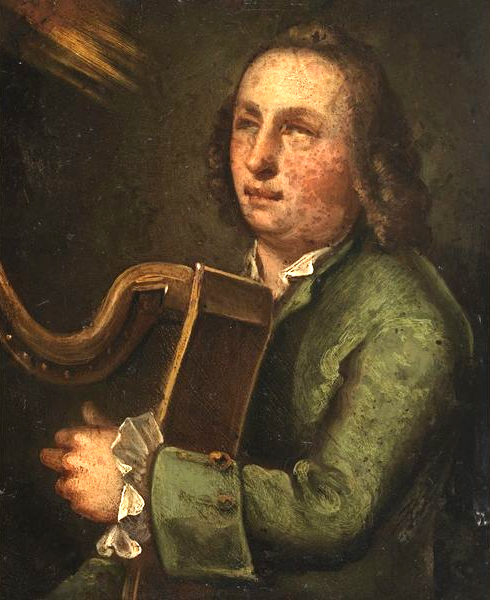
From R.B. Armstrong “The Irish and Highland Harps”, Edinburgh, David Douglas, 1904., Public domain, via Wikimedia Commons
So how did his music survive? And what can these historical sources actually tell us?
The First Printed Sources: John and William Neal (1724)
One of the most important early sources is A Collection of the Most Celebrated Irish Tunes, published in Dublin by John and William Neal in 1724.
This collection contains 49 Irish tunes, including several associated with O’Carolan. Among them are Fairy Queen, Carolan’s Devotion, and Grace Nugent.
What makes this publication particularly valuable is its date: O’Carolan was still alive when it appeared.
We therefore have written versions of some of his melodies that were circulating during his own lifetime.
However, we should not assume that every note represents exactly what O’Carolan played. The collection was intended for instruments such as the violin, flute, and oboe, rather than specifically documenting his harp performances.
And although some compositions are explicitly attributed to him, others have been identified through later research.
The Irish Traditional Music Archive (ITMA) provides access to the tunes from this remarkable collection.
Explore the source: Neal’s Collection of the Most Celebrated Irish Tunes (1724) – ITMA
The Mysterious Carolan–Delaney Fragment (c. 1748)
Perhaps the most intriguing source is an incomplete printed collection known as the Carolan–Delaney Fragment.
Only 14 pages survive, containing 23 tunes traditionally attributed to O’Carolan. The fragment is preserved in the National Library of Ireland.
Researchers have connected it with a publication produced shortly after O’Carolan’s death, possibly involving his son and the musician Dennis Connor. The precise publication history is not entirely settled.
What makes this fragment especially interesting is that the melodies are accompanied by written bass parts.
This raises an important question: did O’Carolan compose these bass lines himself?
An account published in the nineteenth century, drawing on earlier testimony, claims that O’Carolan’s tunes originally had no written bass and that bass parts were added after his death when his music was arranged for instruments such as the harpsichord, violin, and flute.
That does not necessarily mean he performed his melodies without accompaniment. A harper could certainly have played bass notes, chords, or other accompanying figures without writing them down.
It simply means we cannot confidently identify the surviving bass parts as O’Carolan’s own.
For anyone interested in arranging his music today, that distinction matters.
Explore the source: The Carolan Fragment – Early Gaelic Harp Info
Later Eighteenth-Century Collections: The Lee Editions
O’Carolan’s compositions continued to appear in printed collections throughout the eighteenth century.
Among the most important are the editions associated with the Dublin music publishers Edmund and John Lee, dating from approximately the late 1770s and 1780.
These collections brought together dozens of melodies attributed to O’Carolan, sometimes with bass parts and arrangements suitable for contemporary domestic music-making.
They were important in transmitting his music beyond the traditional harp repertoire.
But here, too, we encounter a difficulty: the published versions may reflect editorial choices, changing musical tastes, or adaptations for instruments other than the Irish harp.
The relationships between the various Lee editions and earlier publications are not always clear. Their contents are therefore valuable historical evidence, but not necessarily direct records of O’Carolan’s performances.
Explore the source: Lee’s Carolan Collections – Early Gaelic Harp Info
Edward Bunting and the Last Traditional Harpers
Another central figure in the preservation of Irish harp music was Edward Bunting (1773–1843).
In 1792, Bunting was commissioned to record the music performed at the Belfast Harp Festival, where some of the remaining professional Irish harpers had gathered.
He subsequently travelled through Ireland, collecting music and information about the harp tradition.
His three major collections appeared in:
- 1797: A General Collection of the Ancient Irish Music
- 1809: A General Collection of the Ancient Music of Ireland
- 1840: The Ancient Music of Ireland
The first volume is often dated 1796 in older publications, but modern research has established that the published collection appeared in 1797.
Bunting’s work is enormously important because he recorded music from performers who still belonged to the traditional Irish harp culture.
However, O’Carolan had died more than fifty years before the Belfast Harp Festival. Bunting never heard him play.
Furthermore, Bunting arranged much of the music for the pianoforte. His printed versions therefore reflect not only the melodies he collected but also his own musical training and editorial decisions.
The distinction between Bunting’s original manuscript transcriptions and his published arrangements is particularly important when investigating historical performance practice.
Explore the source: Edward Bunting’s First Collection (1797) – ITMA
Donal O’Sullivan: The Modern Reference Collection
In 1958, the music historian Donal O’Sullivan published his monumental two-volume study:
Carolan: The Life, Times and Music of an Irish Harper.
O’Sullivan brought together 214 compositions attributed to O’Carolan, examined historical sources, and documented the stories and individuals associated with the tunes.
His work remains
 I'm Silke, and I create the musical learning materials I once wished I had. I'm not Irish, but at least I'm a redhead! 😉


